What is AI-native DevOps? A working definition
AI-native DevOps is a delivery process in which autonomous agents are first-class actors on the board — with roles, permissions, recorded runs and a cost per work item — rather than tools a developer invokes inside their editor. The practical test is simple: if removing the AI would leave your process unchanged, you are AI-assisted; if your process has statuses, conditions and budgets that only make sense because non-human actors execute work, you are AI-native.
The phrase gets used for two very different things, which is why it has stopped meaning much. It is worth separating them, because the tooling, the risks and the money involved are not the same.
AI-assisted versus AI-native
| AI-assisted development | AI-native delivery | |
|---|---|---|
| Where the AI sits | Inside the developer’s tools: editor, terminal, review comments. | On the board, as an actor with a name, roles and permissions. |
| Who invokes it | A person, per task. | The queue, derived from the state of the work. |
| What is recorded | The result — code, a suggestion, a comment. | The run: model, duration, tokens, cost, outcome, on the work item. |
| What can go wrong | Bad code that a person reviews. | Work that moves without anyone deciding it should. |
| What it costs | A seat licence. | A seat licence plus usage that varies per work item. |
The test that separates them: if you removed every AI tool tomorrow, would your process change? If the answer is “we would be slower”, you are AI-assisted. If the answer is “half the columns on our board would have nobody to work them”, you are AI-native.
Five properties of an AI-native process
1. Agents are actors, not features
An agent has a name that appears on tickets, roles that grant permissions, and a history you can read. It is assigned work the way a colleague is. That sounds like an aesthetic choice and it is a structural one: an actor can be held to a permission model, whereas a feature is simply invoked by whoever holds the button.
2. The board is authoritative, and the chat is a remote control
Conversations are a fine interface and a terrible system of record. In an AI-native process the chat is where you say what should happen and the board is where it is recorded, so that a second person, a second week and a second agent all read the same state.
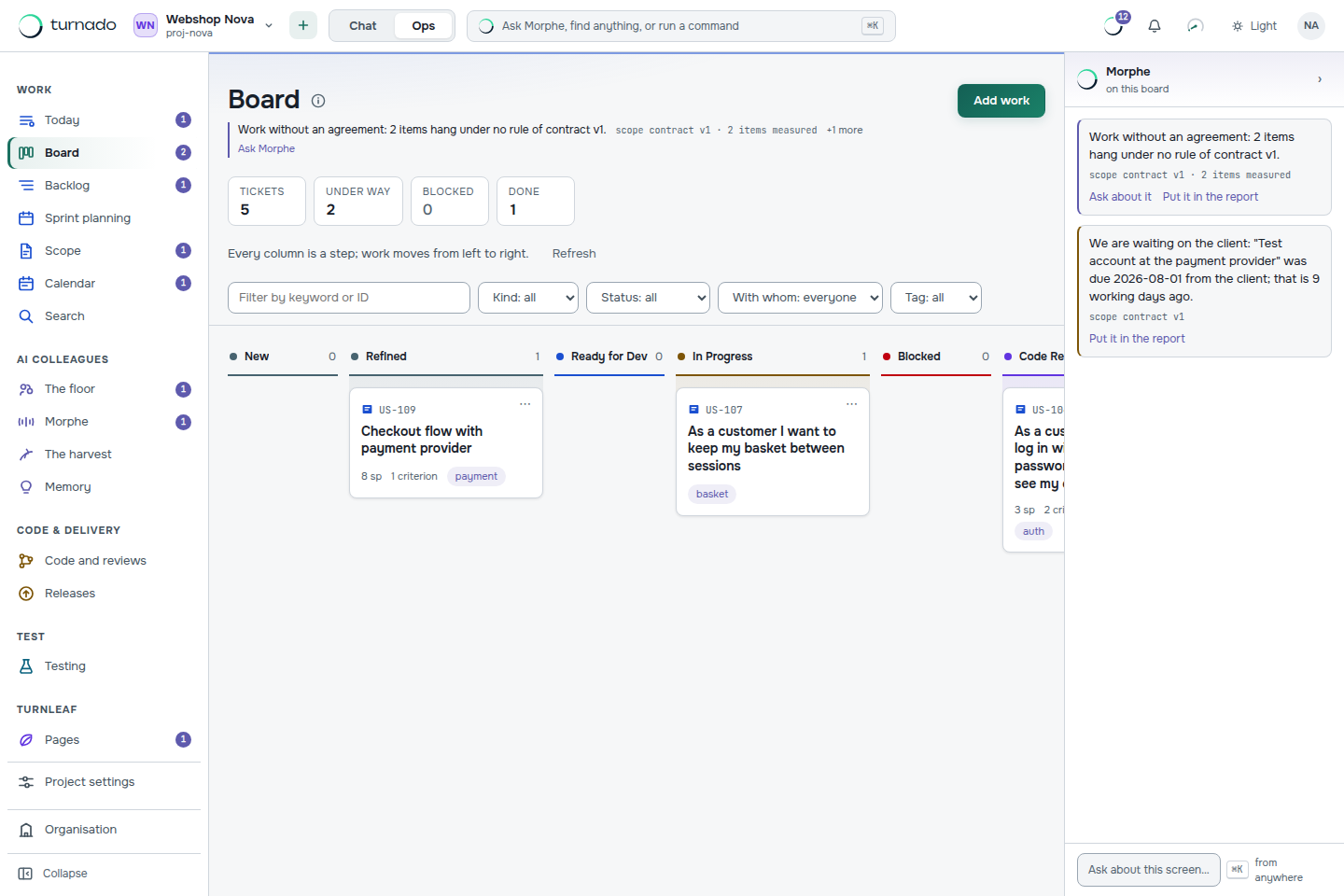
3. Conditions are calculated, not asserted
The claim “it is done” has to be separable from the fact that it is done. That requires conditions evaluated outside the model: CI reported green, a review was submitted by someone who did not write the code, a deployment to TEST actually happened. Without that separation, autonomy is indistinguishable from optimism.
4. Some permissions are unreachable by construction
Every AI-native process needs a list of things no agent gets, regardless of configuration — merging to main, releasing to production, changing the rules of the workflow, rewriting the audit log. The list matters less than where it lives. In a prompt it is a request. In a permission set applied after roles are resolved, it is a guarantee.
5. Cost is attached to work, not to the month
Model usage is the first line item in software delivery that varies per work item and can be attributed to it exactly. Not doing so is a choice to keep the most decision-relevant number of the decade in aggregate form.
What AI-native does not mean
- Not “no people”. The interesting question is which decisions stay human, not how few humans remain. Approvals, merges and releases are the obvious ones.
- Not “no process”. The opposite: agents need more explicit process than people, because they cannot infer the unwritten rules from the room.
- Not “one model does everything”. Writing a rate limiter and classifying a comment are different jobs with different price tags.
- Not “autonomous end to end”. An agent that cannot stop and ask is not autonomous, it is unsupervised.
How to tell where you are today
Four questions, and they are uncomfortable in a useful way. Can you name what your AI usage cost per feature last month? Can an agent in your setup move something to Done? If it did, what stopped it being wrong? And if all your agents stopped this morning, when would you find out?
What is AI-native DevOps in one sentence?
A delivery process in which autonomous agents are first-class actors on the board — carrying roles, permissions, recorded runs and an attributable cost — rather than tools a developer invokes inside their editor.
How is it different from AI-assisted development?
AI-assisted development makes an individual faster inside their own tools and leaves the process unchanged. AI-native delivery changes the process itself: statuses, conditions, budgets and permissions that only make sense because non-human actors execute work.
Do you need new tooling to go AI-native?
You need three things a traditional tracker rarely has by default: conditions calculated outside the model, permissions an agent cannot widen, and cost recorded per work item. Whether you get those by configuring what you have or by changing platform depends on whether your agents act or only suggest.