Turnado vs Claude Code, Cursor and Copilot: what changes when a second person joins
Claude Code, Cursor and GitHub Copilot are strong at writing code inside one session for one person. Turnado does not try to win that ground — the code work here runs on the model you choose. What it adds is what an assistant has no reason to have: a memory that outlives the session, one board two people share, and calculated conditions that separate “the model says it is done” from a tested release.
Every demo of an AI coding assistant is genuinely impressive, and every one of them is a demo of the same shape: one person, one repository, one session, one task. That shape is not a weakness — it is the product. Claude Code, Cursor and GitHub Copilot are built to make a developer faster inside their editor, and they do.
The trouble starts on the second day, with the second person. Not because the assistant got worse, but because the questions changed. Who decided that? What was agreed with the customer about this rule? Is this reviewed? Did anyone test it? Which of the four things we half-built last week is actually finished? None of those questions are about writing code, and none of them have an answer inside a chat window.
Where the line actually sits
| AI coding assistant | Turnado | |
|---|---|---|
| What it is for | Writing, refactoring and explaining code, fast, inside one session. | Running the delivery process: analysis, backlog, sprints, statuses, review, test, release. |
| Where the memory lives | In the session and in the files it can read. | On the board: work items, decisions, runs and status history, with an audit log. |
| How many people | One at a time, per session. | A team, with roles and permissions that mean something. |
| Who says it is done | The model reports back to you and you judge it. | Eighteen calculated conditions — criteria present, CI green, review approved, deployed to TEST, human test passed. |
| Which model | The vendor’s, generally. | Yours, for code work — with your own key if you like. Possibly the same one your assistant uses. |
Read that table again as a stack rather than a contest. The bottom row is the point: Turnado does not compete for the code work. That ground is being fought over by companies with far more money than us, the models are extremely good, and a customer who has already picked one should keep it.
The three things a session cannot give you
1. A memory that survives the week
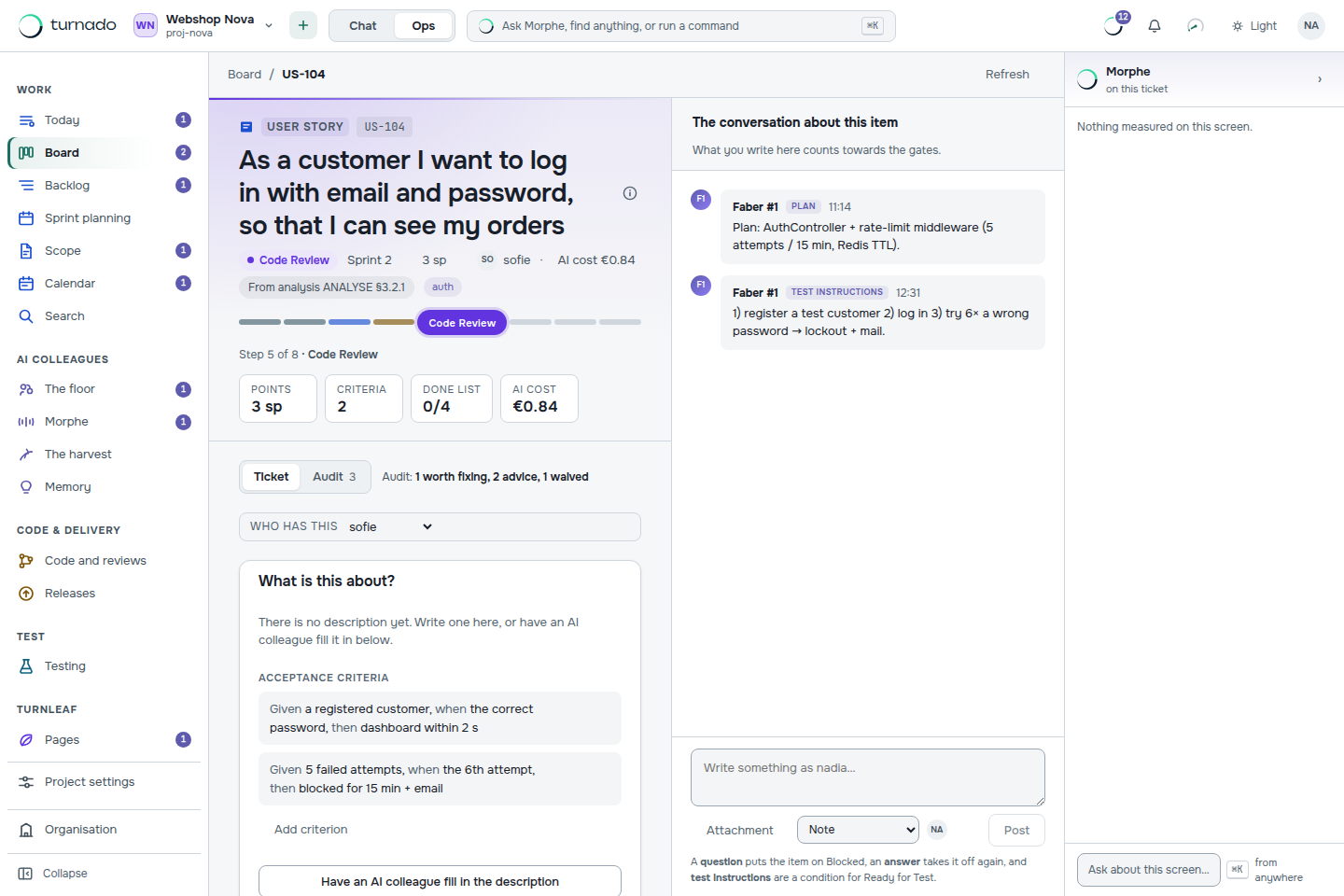
An assistant remembers a session, plus whatever it can re-read from your files. That is enough for a task and not enough for a project. The decision you made on Tuesday — the reason you chose fifteen minutes instead of an hour, the exception the customer asked for, the thing you deliberately did not build — is nowhere by Friday, and the assistant will happily rebuild it differently next time.
In Turnado every instruction lands as a work item and every decision on a ticket, with who set it, when, and on what grounds. Not because tickets are pleasant, but because six months from now the ticket is the only thing that will still exist.
2. One board instead of two private chats
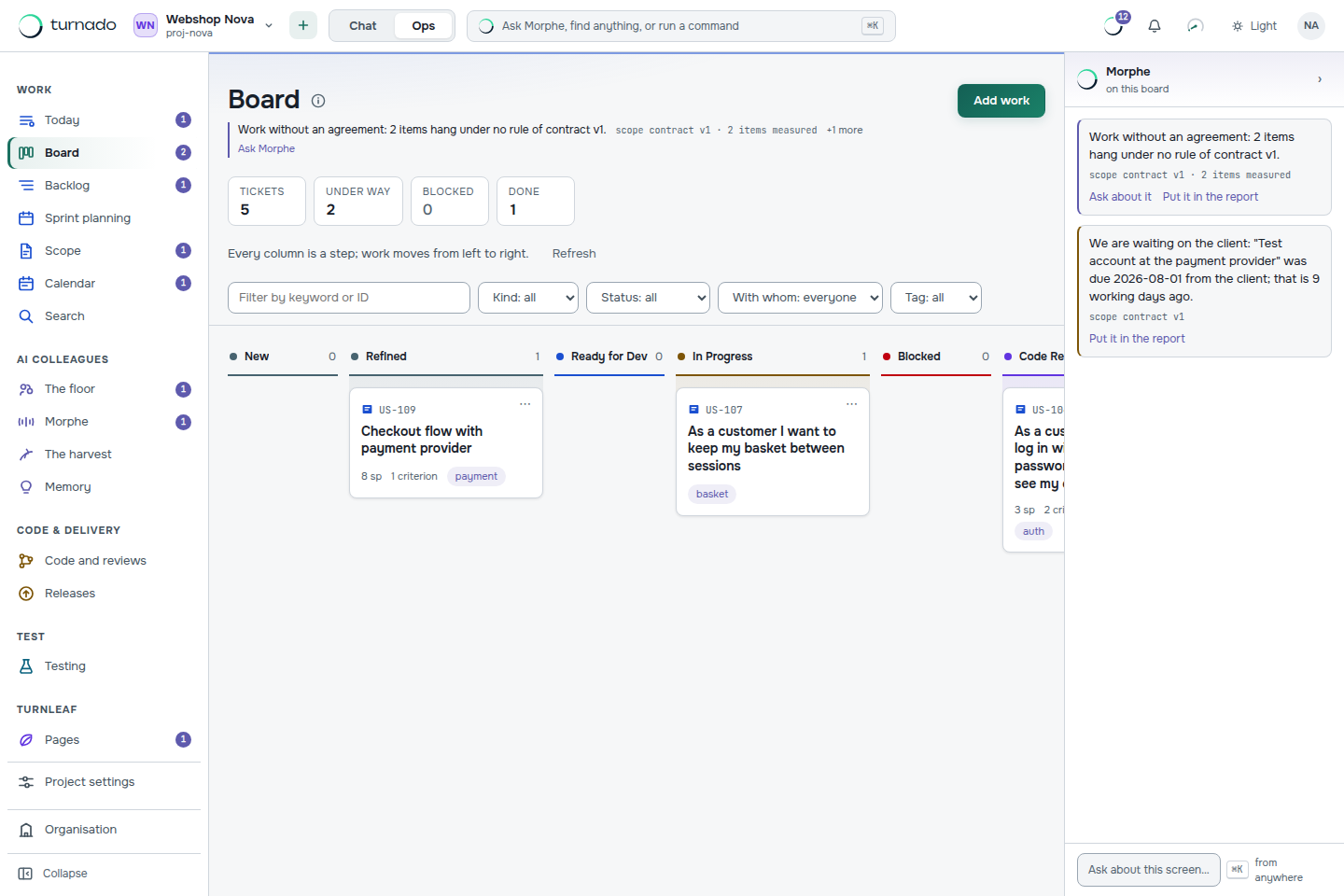
Two developers with two assistant sessions produce two versions of the truth, and they discover the divergence in the merge. This is not a tooling failure; a session is private by design, and privacy is exactly what you do not want from a shared plan.
On a board, people and AI colleagues work in the same columns under the same roles. An agent operating the board uses the same tool contract your buttons use — there is no separate agent mode with extra permissions, because a second, looser path would be precisely the hole every safeguard is meant to close.
3. A process that guards the difference between “done” and done
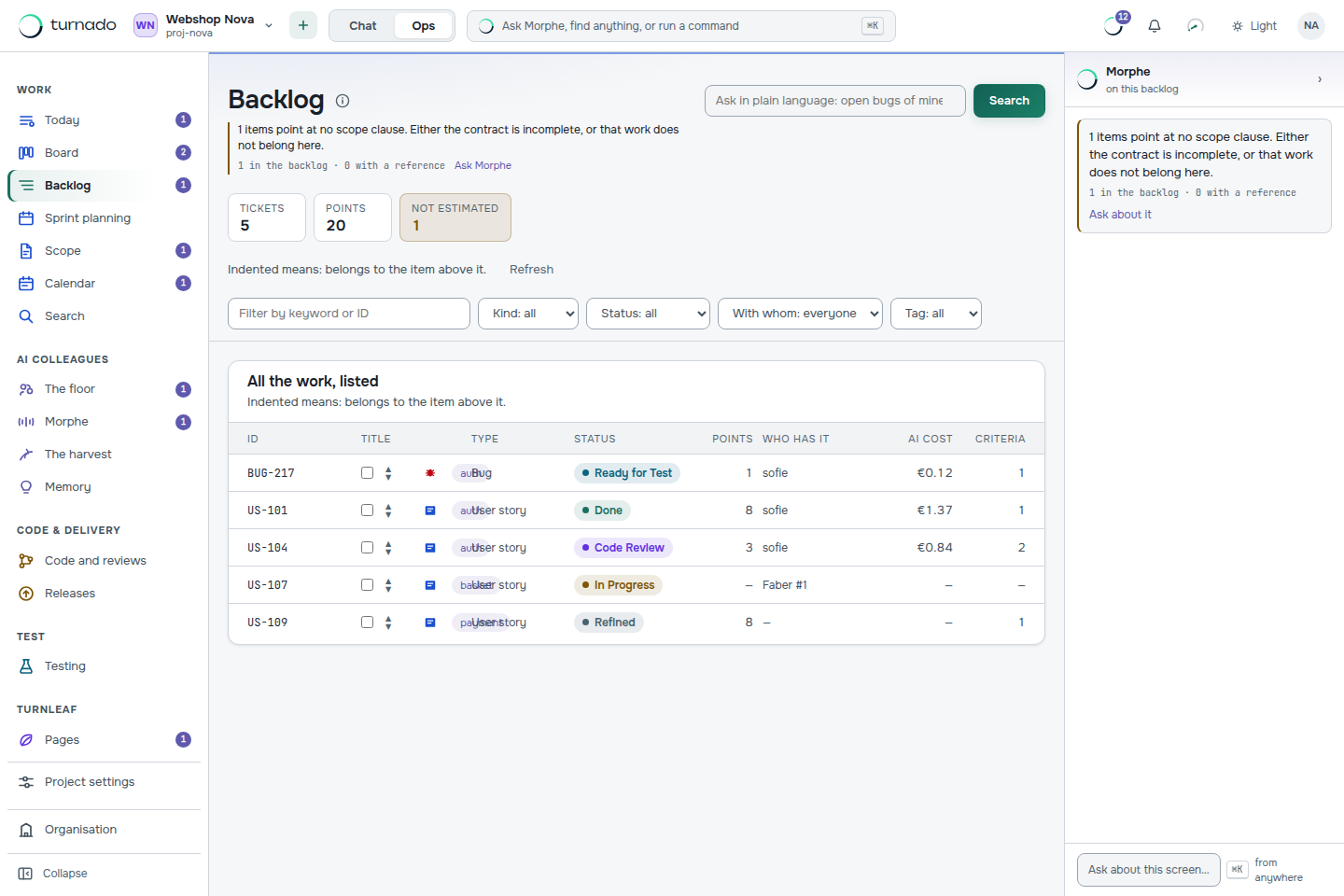
This is the one that costs teams real money. A model reporting success is a claim, not evidence. Turnado has nine statuses, sixteen transitions and eighteen conditions on those transitions, and every condition is a plain function of the state of the work item — no model, no network, no clock. ci_green reads what your pipeline reported. review_approved reads whether a review was submitted by someone who did not write the code.
Because those checks live outside the model, an agent cannot write its own green tick. It can ask for a transition; whether it happens is decided by code it has no access to.
Why not just add tickets to the assistant?
Several assistants can create issues, and that is useful. The difference is direction of authority. When the assistant writes a ticket, the ticket is a note about what the session did. When the board is authoritative, the session is a way of asking the board to do something — and the board can refuse.
That inversion is what makes an audit trail worth having. A record produced by the actor being audited proves very little; a record produced by the system that granted or refused the action proves quite a lot.
When you do not need Turnado
We would rather say this than have you discover it. If you are one developer on your own project, an assistant is enough and a board is overhead. If your work is exploratory — prototypes, spikes, research — the process will slow you down and should. Turnado starts paying for itself when there is someone to account to: a colleague, a customer, an auditor, or yourself in three months.
How they fit together in practice
- The analysis or functional design goes into the intake and comes out as epics, features and user stories with acceptance criteria, each pointing back at the section it came from.
- A story is refined, estimated and planned — by people, with an agent allowed to propose but not to approve.
- Code work runs on the model you chose. Your own key, your own contract, possibly the same assistant your developers already use.
- The pull request opens; CI reports; a reviewing actor that did not write the code approves. Those become gate facts, not claims.
- A human tests, using test instructions posted on the ticket, and only then does the item reach Done.
Is Turnado a replacement for Claude Code or Cursor?
No. Turnado runs the delivery process around the code work, and the code work itself runs on the model you choose — which can be the same model your assistant uses. They are complements: the assistant writes the code, Turnado turns it into agreed, tested and traceable releases.
Can I keep using my existing assistant alongside Turnado?
Yes, and most teams do. Developers keep their editor and their assistant; what changes is that the work they pick up comes from a board with acceptance criteria on it, and what they finish passes gates instead of being declared finished.
What does Turnado do that a coding agent cannot do on its own?
Three things: it keeps a memory outside the session (work items, decisions and runs, six months later), it lets several people and several agents share one authoritative board, and it enforces conditions calculated outside the model so that an agent cannot approve its own work.
Does Turnado train on my code?
No. Code work runs on the model you configure, under your contract with that provider, and you can bring your own key or your own endpoint. The process work runs on our own European model; you can also configure that only EU-hosted models may be used at all, and a choice outside that is refused with the reason attached.