How to choose a model per kind of work, and keep it in the EU
Turnado splits work into three kinds and picks one model per kind. This is how to connect a key, what each kind costs, and how to refuse any model that runs outside the EU.
There is no single best model for everything an AI-native delivery platform does. Writing a rate limiter and classifying a comment on a ticket are different jobs with different price tags, and paying the frontier price for both is how AI budgets disappear. Turnado therefore splits the work into three kinds and picks one model per kind.
The three kinds of work
| Kind | Which agents | Whose model |
|---|---|---|
| Code work | Dev, Review | Yours. This is the ground the big models fight over and we do not try to win there — pick what you already trust, with your own key if you like. |
| Process work, heavy reasoning | Intake, Decomposition, Planner | Configurable. Turning a messy document into a defensible backlog is genuinely hard reasoning, so it is worth a strong model. |
| Process work, routine | Test, Release, Comment, Docs | Turnado‑1, our own process model, EU-hosted. High volume, low variance — exactly what a smaller, cheaper, closer model is for. |
Connecting a key
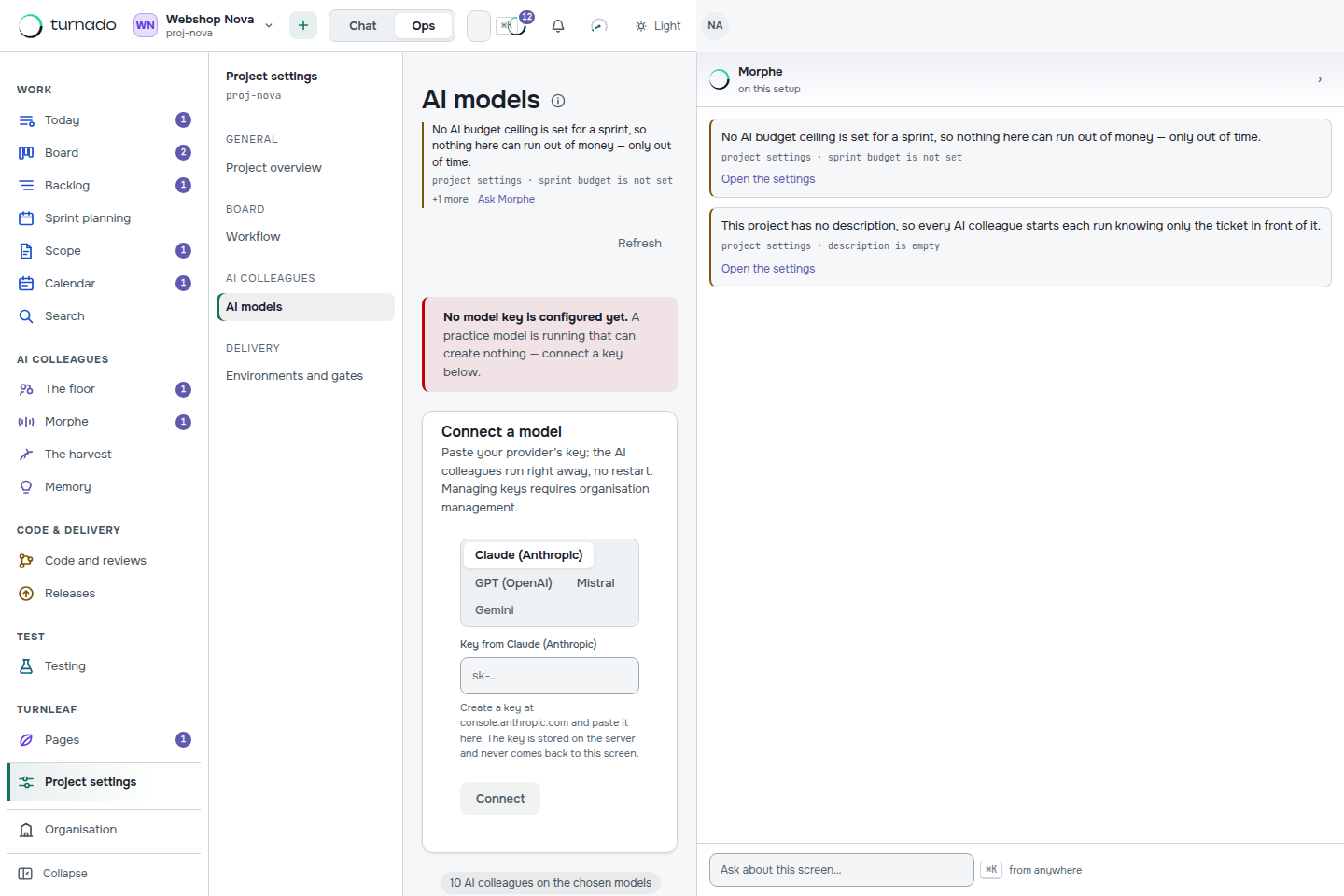
Open Project settings → AI models
Without a key, a practice model runs. It lets you click through every screen and it can create nothing — which is honest, and a lot less confusing than empty results.
Pick your provider and paste the key
Anthropic, OpenAI, Mistral or Google. The key is stored on the server and never comes back to the screen. Managing keys requires organisation management, so it is not something any project member can change.
The agents use it immediately
No restart, no redeploy. The next round of the queue runs on the model you just connected.
Set the per-task cap
A ceiling per task — three euros by default — stops a runaway agent loop before it becomes a line on an invoice. See Keeping the AI bill predictable.
Enforcing EU hosting
Every model in the catalogue states where it runs, and the label is on the screen next to the choice rather than in a policy document. An organisation can set the rule that only EU-hosted models may be used; a choice outside that is then refused, with the reason attached rather than an error code.
That is the difference between a promise and a control. “We are EU-first” is a sentence; a configuration that refuses a US endpoint at the moment of the call is something an auditor can test. The process work runs on Turnado‑1 at Mistral in France, so a team that switches EU-only on does not lose the part of the platform that is ours.
Reading the price
Each model shows a guide price per million tokens it reads and per million it writes. Those two are usually a factor of five apart, which is why a model choice for a high-volume routine job matters more than it looks: the same monthly bill can be one strong model doing everything or a sensible split doing the same work.
Does using my own key make the subscription cheaper?
No, and that is deliberate. You pay for the board, the gates and the agents walking over them — not for reselling tokens. What your own key does do is take that work off your plan allowance and out from under its ceiling entirely.
Can I use a model hosted inside my own network?
For code work you can supply your own endpoint, including a model running inside your own walls. Process work runs on our European model and is part of the plan; asking for a key for that would cost more administration than the amount involved.
What happens if a model is unavailable?
The model policy falls back, and the fallback is recorded with its reason. You can see afterwards which model actually did the work rather than which one was supposed to — that difference is exactly what makes a cost report trustworthy.