How to plan a sprint within capacity and AI budget
A sprint in Turnado has two ceilings: the hours your people have and the euros the agents may spend. This is how to compose one, and what to do with the items that fall outside it.
Sprint planning normally answers one question: does this fit in the time we have? With AI colleagues on the team there is a second question, and it is just as hard to answer after the fact: does this fit in the money we are willing to spend on model usage? Turnado asks both at once, because a sprint that fits in hours but not in budget stalls halfway through with no warning.
The three numbers you give it
| Field | What it means |
|---|---|
| Capacity in points | What your team can handle this sprint, in story points. The ordinary velocity number you already use. |
| AI budget in euros | What the agents together may spend this sprint. Zero means no limit — which is a choice, not a default. |
| Cost per item in euro cents | What one item costs in AI on average. Twenty-five cents is the default; after a few sprints your own measured figure is better. |
What the proposal does
It fills the sprint until one of the two ceilings is reached, respecting the order of the backlog and putting predecessors before the items that depend on them. Epics and features do not consume capacity — they are containers, not work.
Every item that does not make it carries the reason why. Over capacity, over budget, waiting on a predecessor, no estimate. That list is the useful half of the output: it is your agenda for the planning meeting.
Watching the sprint while it runs
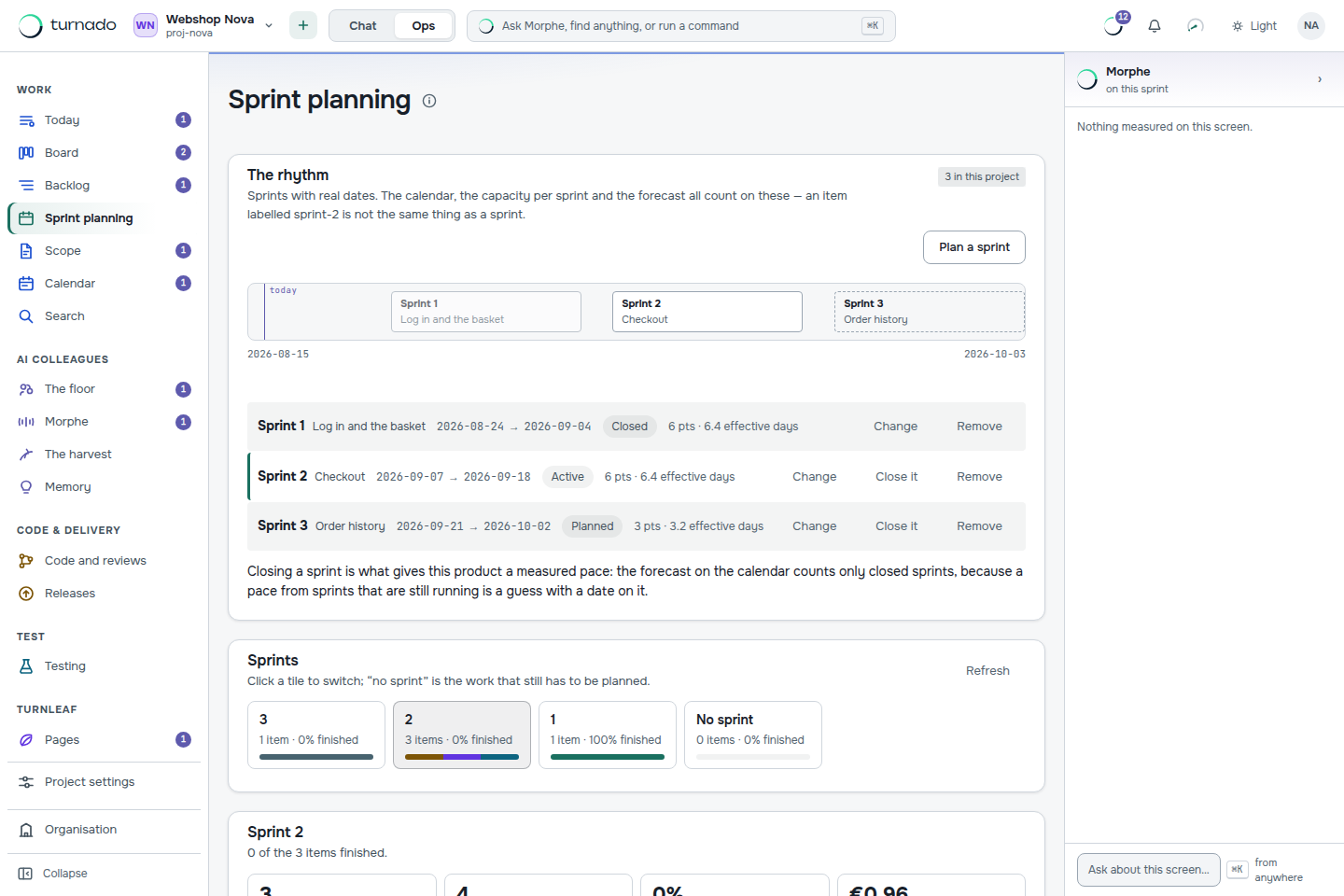
- On the sprint screen — items, points, percentage finished, and the AI cost so far against the budget you set.
- On the Queue — the sprint budget is shown with what has been spent and what is reserved for work that is ready. When the budget is reached, agents stop and ask rather than continue.
- On the dashboard — the burndown, how much was finished without a person having to step in, and how long items stood still waiting on someone.
When the budget runs out mid-sprint
Nothing dramatic happens: the agents stop picking up new work and say so, with the reason attached. You either raise the budget, or you let the remaining items wait for the next sprint, or people pick them up. What does not happen is an invoice with a surprise on it — see Keeping the AI bill predictable.
Do AI colleagues consume capacity in points?
No. Points are your people’s capacity; the agents have their own ceiling in euros. Mixing the two into one number would hide exactly the trade-off you are trying to see.
What is a realistic cost per item?
It depends entirely on the model you chose for code work and on how large your stories are. Start with the default of twenty-five cents, then read the measured AI cost per item on the dashboard after a sprint and put your own number in.
Can an agent approve a sprint?
It can propose one; approving is a human permission (sprint:approve) and the transition into Ready for Dev deliberately excludes agents. Planning is a commitment to other people, and a commitment is not something an agent gets to make on your behalf.